
The Aravalli range, one of the oldest mountain systems in the world, stands as a geological witness to Earth’s deep past. Formed over 2.5 billion years ago during the early Proterozoic era, these ancient hills once rivaled the Himalayas in height and grandeur. Stretching approximately 670 kilometers from Gujarat through Rajasthan to Haryana and Delhi, the Aravallis have shaped the climate, ecology, and human civilization of northwestern India for millennia. Today, however, this timeless mountain range faces an unprecedented crisis. Scientific assessments and environmental studies warn that if current trends continue unchecked, large parts of the Aravalli system could effectively vanish by 2059.
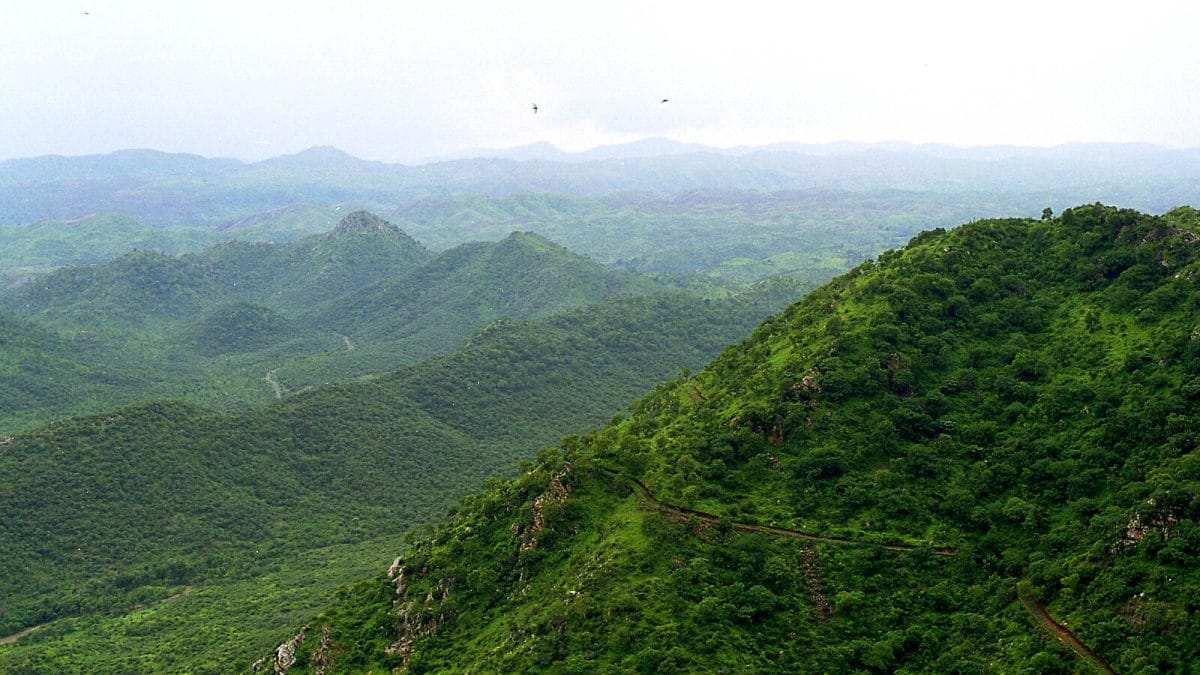
Table of Contents
ToggleGeological and Ecological Significance
The Aravallis are not merely a chain of hills; they are a geological archive of Earth’s formative processes. Their rocks record some of the earliest episodes of continental formation, tectonic activity, and mineralization. Over billions of years, erosion reduced their once towering peaks into the rugged, low-lying hills seen today. Despite their modest height, the Aravallis continue to play a vital role in maintaining ecological balance across northwestern India.
Ecologically, the range acts as a natural barrier that influences rainfall patterns, prevents the eastward expansion of the Thar Desert, and supports diverse ecosystems. The forests of the Aravallis host a variety of flora and fauna, including leopards, hyenas, jackals, migratory birds, and countless plant species adapted to semi-arid conditions. The hills also serve as crucial groundwater recharge zones, allowing rainwater to percolate through fractured rocks and replenish aquifers that supply water to millions of people in Rajasthan, Haryana, and the National Capital Region.
websitereviewer.org | CryptoCheaps.com | SoundsLikeThis.net
ipcsections.com | auto-dim.com
Human Dependence and Cultural Importance
Human settlements have long depended on the Aravallis for water, minerals, and protection. Ancient civilizations thrived along its foothills, using its resources for agriculture and trade. Even today, cities such as Delhi, Gurugram, Faridabad, Jaipur, and Udaipur rely heavily on the range for climate moderation, water security, and air purification. The Aravallis help reduce dust storms, improve air quality, and moderate extreme temperatures in surrounding regions.
Culturally, the range features prominently in local folklore, religious traditions, and historical narratives. Sacred groves, temples, and heritage sites scattered across the hills reflect centuries of coexistence between humans and nature.
Causes Behind the Decline
Despite its immense value, the Aravalli range has suffered decades of relentless degradation. The primary drivers of its decline include illegal mining, deforestation, urban expansion, and weak enforcement of environmental regulations.
Mining has been the most destructive force. Rich deposits of marble, granite, quartzite, limestone, and other minerals have attracted extensive quarrying. Unregulated and illegal mining operations have flattened hills, destabilized rock formations, and destroyed vegetation cover. Blasting and excavation have fractured the ancient rock systems, permanently altering their structure and hydrology.
Rapid urbanization has compounded the damage. As cities expand, forest land is cleared for housing projects, roads, and industrial zones. The natural contours of the hills are leveled, and valleys are filled, disrupting drainage patterns and increasing the risk of floods during monsoons and water scarcity during dry seasons.
Deforestation for fuelwood, agriculture, and development has further weakened the ecosystem. Loss of tree cover accelerates soil erosion, reduces biodiversity, and limits the land’s ability to absorb and retain water. Climate change adds another layer of stress, with rising temperatures and erratic rainfall patterns intensifying desertification processes.
The Alarming Projection: Disappearance by 2059
The projection that the Aravallis could vanish by 2059 does not imply that the mountains will suddenly disappear. Rather, it indicates that continued degradation could render large stretches ecologically and functionally extinct. Hills may be reduced to rubble, forests replaced by barren land, and groundwater systems irreversibly damaged.
Such a collapse would have severe consequences. The Thar Desert could advance eastward, affecting agricultural productivity across Rajasthan, Haryana, and western Uttar Pradesh. Water scarcity would intensify in already stressed urban centers, leading to increased dependence on distant and unsustainable water sources. Air quality in the National Capital Region could worsen as the natural green barrier diminishes, exacerbating health crises linked to pollution.
Legal Protections and Their Limitations
Over the years, several legal and policy measures have aimed to protect the Aravallis. Mining bans, environmental clearance requirements, and forest conservation laws exist on paper. Judicial interventions have repeatedly recognized the ecological importance of the range and ordered restrictions on destructive activities.
However, enforcement remains inconsistent. Loopholes in land classification, political pressures, and economic interests often undermine conservation efforts. Areas designated as “non-forest” or “revenue land” are particularly vulnerable, despite being ecologically integral to the mountain system.
The Path Forward: Conservation and Restoration
Preventing the collapse of the Aravallis requires urgent, coordinated action. First, strict enforcement of existing laws is essential. Illegal mining must be completely halted, with real penalties for violations. Transparent monitoring systems using satellite imagery and ground inspections can help track changes and ensure accountability.
Second, large-scale ecological restoration is needed. Reforestation with native species, soil stabilization measures, and revival of traditional water-harvesting systems can gradually restore degraded landscapes. Protecting wildlife corridors will help maintain biodiversity and ecological resilience.
Third, sustainable urban planning must become a priority. Development projects should respect natural contours, avoid ecologically sensitive zones, and incorporate green buffers. Community participation is equally crucial. Local populations, when empowered and incentivized, can become the strongest custodians of the landscape.
Finally, public awareness and political will are key. Recognizing the Aravallis not as expendable land but as critical natural infrastructure can shift policy priorities. Education, research, and long-term environmental planning must guide decisions affecting the range.
Conclusion
The Aravalli range has endured for over 2.5 billion years, surviving tectonic upheavals, climatic shifts, and the passage of civilizations. Yet, it now faces its greatest threat from human activity within a matter of decades. The possibility of its functional disappearance by 2059 is a stark reminder of the consequences of neglecting natural heritage.
Saving the Aravallis is not merely about preserving ancient hills; it is about securing water, climate stability, biodiversity, and quality of life for future generations. The choice lies in collective action today—whether to allow one of Earth’s oldest mountain systems to fade into history or to restore and protect it as a living legacy of our planet’s deep past.
