
In a shocking development that has rattled security agencies, four doctors were arrested within four days across different parts of the country for their alleged involvement in terror-related activities. The arrests have brought to light a disturbing trend of radicalisation among highly educated professionals, raising new concerns about the evolving face of terrorism in India.
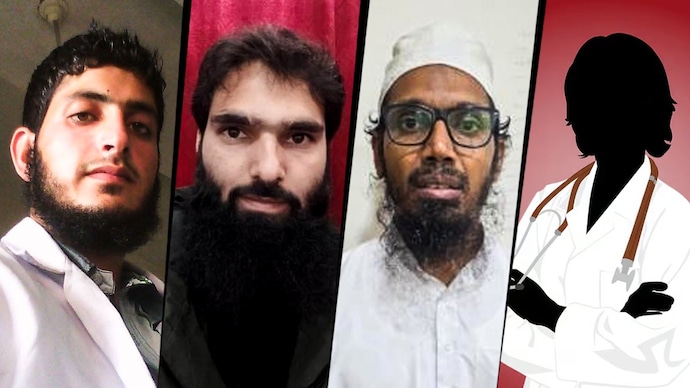
According to police reports and intelligence officials, the four medical professionals were found in possession of firearms, ammonium nitrate, and even ricin — a highly lethal chemical agent. These materials, experts say, indicate advanced planning and possible links with international terror networks.
The Arrests: Four Days, Four Doctors
The arrests, carried out by coordinated teams from central and state intelligence agencies, began earlier this week and were spread over four consecutive days. Each case has unveiled layers of a possible larger network that uses professionals and educated individuals as covert operatives or logistical supporters.
Authorities revealed that at least two of the arrested doctors were practicing in private hospitals, while the others were associated with research and academic institutions. Their backgrounds, on paper, reflected success and social standing — yet, investigations suggest that they were drawn into extremist ideologies through online propaganda and encrypted communication platforms.
Preliminary probes indicate that these doctors were in touch with handlers based abroad. The recovered chemicals — including ricin, ammonium nitrate, and other precursors — are commonly used in the making of improvised explosive devices (IEDs) and biological weapons.
movevacations.com | sugarlanedesign.com | autofixteam.com
secureautoin.com | gotickettravel.com
A Chilling Pattern Emerges
What has alarmed officials most is the pattern of recruitment. Unlike traditional terror operatives, these individuals belong to educated, upper-middle-class backgrounds with access to advanced knowledge of chemistry, biology, and medicine.
This new form of extremism, described by intelligence sources as “white-collar radicalisation”, signifies how extremist networks are shifting tactics — moving beyond conventional training camps to exploit digital influence and intellectual expertise.
Officials believe that such individuals are often indoctrinated slowly through ideological narratives online, framed as scientific or humanitarian causes, before being introduced to more radical content.
Use of Chemicals and Firearms
The seizure of ricin — a highly toxic substance derived from castor beans — has caused particular concern. Ricin can be used as a biological weapon, and even small amounts can prove fatal if inhaled or injected.
Alongside ricin, police also found ammonium nitrate, a key ingredient in several past bomb blasts in India and abroad. The recovered automatic rifles and ammunition point to possible plans for targeted attacks or assassinations.
Authorities are now investigating whether these doctors were preparing to supply such materials to other operatives or were part of a cell planning attacks themselves.
How Radicalisation Happened
Early reports from digital forensics reveal that most of the arrested doctors had been communicating via encrypted messaging apps. They were part of closed online groups, some of which were managed by handlers operating from outside India.
Investigators believe these groups often begin under the guise of academic or humanitarian discussions, drawing in educated minds by discussing international politics, social injustice, or medical ethics — before gradually introducing ideological extremism.
Such gradual indoctrination ensures that the individuals remain unsuspected in society, making them ideal recruits for covert terror missions.
Security Agencies on Alert
Following the arrests, the National Investigation Agency (NIA) and Intelligence Bureau (IB) have intensified their focus on identifying similar networks targeting professionals in fields like engineering, research, and medicine.
A senior official commented,
“This is not a one-off case. The pattern is systematic. Radical groups are deliberately targeting professionals — people who can easily travel, communicate globally, and handle complex technologies.”
Cyber units are currently tracking the online footprints of several users who interacted with the arrested doctors. Investigators are also examining whether foreign funding or digital crypto transfers were used to support their activities.
Past Incidents Show Similar Trends
This is not the first time that educated individuals have been linked to extremist activities. Over the years, several cases in India and abroad have shown how people from professional backgrounds — including engineers, researchers, and doctors — were drawn into terrorism.
Globally, terror organisations like ISIS and Al-Qaeda have often targeted educated recruits for their technical and logistical expertise. They are seen as capable of developing chemical, biological, or cyber-based threats — far beyond the traditional bomb-making operations.
In India, security agencies have previously busted small groups of students and professionals planning cyberattacks or making IEDs using instructions found online.
Experts Warn of a Dangerous Shift
Counterterrorism experts warn that this new development represents a dangerous evolution of terrorism. Instead of uneducated or impoverished recruits, extremist ideologies are now attracting skilled individuals who can operate invisibly within society.
Dr. Rajesh Purohit, a counter-radicalisation expert, notes:
“The presence of doctors and scientists in terror networks changes the game. They can create or access dangerous materials without raising suspicion, and they understand how to evade detection.”
He added that ideological radicalisation among educated minds is harder to reverse because it often comes wrapped in a sense of intellectual justification or moral superiority.
Government Response and Next Steps
The Ministry of Home Affairs has directed intelligence agencies to conduct a nationwide audit of sensitive materials like chemicals and laboratory-grade substances that can be misused. Universities and hospitals have also been instructed to tighten access control to research facilities and maintain digital records of chemical inventories.
Police departments across multiple states are collaborating to map potential sleeper cells linked to the arrested doctors. Interrogations are ongoing to identify whether they were part of a larger transnational network.
Meanwhile, social media companies and encrypted app developers have been asked to cooperate with investigators to trace the origins of the online groups responsible for spreading radical ideologies.
A Wake-Up Call for Society
The arrest of four doctors in just four days has left many questioning how deeply extremist ideologies can infiltrate modern, educated circles. These individuals were once seen as healers and contributors to society — yet somehow, they were turned into instruments of potential destruction.
This unsettling trend serves as a wake-up call — not just for law enforcement, but for society as a whole. Radicalisation no longer targets only the poor or uneducated; it now seeks to manipulate intellect, emotion, and identity.
As investigations continue, authorities are urging institutions, families, and communities to remain alert to sudden behavioral or ideological shifts among peers and colleagues, especially those active in online discussion groups.
Conclusion
The four arrests underscore a grim reality: the face of terrorism is changing. With educated professionals now being drawn into extremist webs, terrorism is no longer confined to traditional battlefields.
This is a white-collar version of radicalisation, driven by ideology, intelligence, and access to dangerous technology.
While the law takes its course, the bigger challenge lies ahead — preventing minds from being manipulated before it’s too late.
