
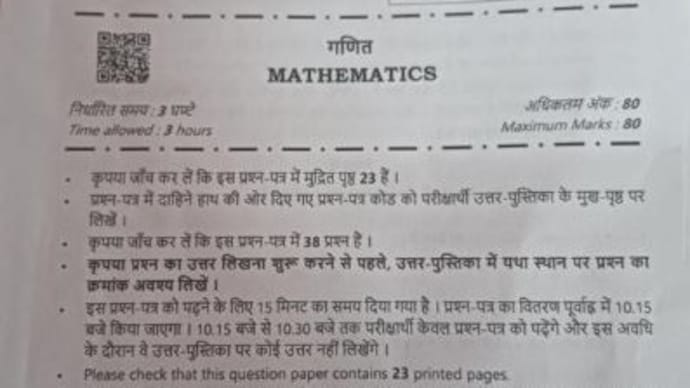
The Central Board of Secondary Education recently addressed an unusual controversy that gained widespread attention on social media. During the CBSE Class 12 Board Examination, students and internet users noticed that a QR code printed on a mathematics question paper appeared to redirect users to the famous music video Never Gonna Give You Up by Rick Astley.
This unexpected discovery quickly went viral online because it resembled a popular internet prank known as “rickrolling.” The prank typically involves tricking someone into clicking a link that unexpectedly leads to the iconic song’s music video. As the incident circulated widely across social media platforms, concerns were raised about the security and integrity of the board examination papers.
In response to these concerns, CBSE issued an official clarification stating that the mathematics question papers used in the examination were genuine and that the security of the board examination system remained fully intact. The board emphasized that the viral claims had been misunderstood and that the QR code in question did not compromise exam integrity.
Table of Contents
ToggleUnderstanding the Viral QR Code Incident
The controversy began when images of the mathematics question paper started circulating online. Observers noticed that a QR code printed on the document appeared to redirect to a video of the song “Never Gonna Give You Up.” This immediately caught the attention of internet users because the song is strongly associated with the online prank culture of rickrolling.
Rickrolling has existed on the internet for many years and is widely recognized as a harmless prank in which people are redirected to the same music video unexpectedly. Because of its humorous nature, the idea that such a prank could appear in an official examination paper seemed both surprising and confusing.
Once the images spread across social media, speculation began regarding whether the QR code had been intentionally placed as a prank or whether the question paper had been compromised in some way. Students and parents expressed concern, wondering whether the exam security system had been breached.
The rapid spread of the incident highlighted how quickly information—and sometimes misinformation—can circulate online.
CBSE’s Official Clarification
Following the viral discussions, the Central Board of Secondary Education released a clarification to address the confusion. The board explained that the mathematics question papers used in the examination were authentic and had been distributed through the standard secure process.
According to CBSE, the QR code printed on the question paper is part of the board’s security and tracking system. These codes are typically included to help authorities verify the authenticity of the document and identify its source if necessary.
The board stated that the presence of the QR code linking to the viral video did not indicate a security breach. Instead, the situation resulted from misunderstandings regarding the purpose and functioning of the code.
CBSE reassured students, parents, and educators that the integrity of the examination process had not been compromised in any way. The board also emphasized that its security protocols remain robust and reliable.
The Role of QR Codes in Examination Security
In recent years, educational boards and examination authorities have increasingly adopted digital tools to enhance the security of question papers. QR codes are one such technology that helps ensure transparency and traceability.
These codes can store encrypted information related to the examination paper, such as identification details and distribution tracking data. When scanned by authorized systems, the QR code helps verify whether the document is genuine.
The use of QR codes allows examination boards to detect potential leaks, identify unauthorized copies, and maintain strict control over the distribution process.
In the case of CBSE examinations, QR codes are integrated into the question papers as part of a broader effort to modernize exam security and reduce the risk of malpractice.
Therefore, the presence of such codes should not be interpreted as unusual; instead, they represent an important step toward strengthening the reliability of the examination system.
How Internet Culture Influenced the Reaction
The strong reaction to the incident can be partly attributed to the influence of internet culture. The song “Never Gonna Give You Up” by Rick Astley has become synonymous with the rickrolling prank, which has been widely shared online for over a decade.
Because the song is so closely associated with this prank, any unexpected appearance of it—especially in a formal setting like an examination paper—naturally draws attention and humor.
Social media platforms amplify such incidents rapidly. Within hours of the images appearing online, thousands of users were discussing the matter, sharing jokes, and speculating about how the QR code could have led to the video.
While the situation generated amusement for many internet users, it also raised legitimate questions about the reliability of examination procedures. This made it important for CBSE to issue a clear and timely clarification.
Ensuring Trust in the Examination System
Board examinations play a crucial role in the academic lives of students. For millions of students across India, CBSE exams determine educational pathways and future opportunities.
Because of this importance, maintaining trust in the examination system is essential. Even minor controversies can create anxiety among students and parents if they are not addressed promptly.
By issuing an official statement, CBSE aimed to reassure the public that the system remains secure. The board highlighted that multiple layers of safeguards are in place to prevent leaks or tampering with question papers.
These safeguards include secure printing processes, controlled distribution channels, digital tracking technologies, and strict monitoring during the examination period.
Such measures help ensure that examinations remain fair and transparent for all students.
The Impact of Social Media on Educational News
The viral spread of the QR code incident also demonstrates how social media has transformed the way educational news is shared and discussed.
In earlier times, such incidents might have remained unnoticed or been limited to small discussions. Today, however, a single image or post can reach millions of users within minutes.
While social media can help highlight issues quickly, it can also lead to misunderstandings if information is shared without proper verification.
In the case of the CBSE mathematics paper, the rapid spread of speculation created confusion before official clarification could be issued.
This situation highlights the importance of verifying information through credible sources before drawing conclusions.
Lessons from the Incident
Although the QR code controversy ultimately turned out to be harmless, it offers several important lessons for students, educators, and authorities.
First, it demonstrates how quickly digital content can go viral and shape public perception. Even a small detail in an official document can become the center of national discussion.
Second, it highlights the importance of transparency and prompt communication from institutions. CBSE’s clarification helped resolve confusion and restore confidence in the examination system.
Third, the incident reminds students and the public to approach viral claims with caution. Not every unusual discovery indicates a problem, and official explanations often provide a clearer understanding of the situation.
Conclusion
The viral QR code incident involving the CBSE Class 12 mathematics examination attracted widespread attention because it appeared to reference the famous “rickrolling” internet prank. However, the Central Board of Secondary Education quickly clarified that the question papers were authentic and that exam security had not been compromised.
The episode illustrates the intersection of modern technology, internet culture, and educational administration. While the unexpected connection to a popular online prank created curiosity and humor, it also underscored the importance of maintaining trust in the examination process.
By reaffirming the strength of its security measures and explaining the purpose of QR codes in question papers, CBSE has reassured students and parents that the integrity of the board examinations remains intact. As digital tools continue to shape the future of education, such incidents also serve as reminders of the need for accurate information and responsible communication in the digital age.
filmy4wapps filmy4wapps filmy4wapps filmy4wapps filmy4wapps filmy4wapps filmy4wapps filmy4wapps filmy4wapps filmy4wapps filmy4wapps filmy4wapps filmy4wapps filmy4wapps filmy4wapps filmy4wapps filmy4wapps filmy4wapps filmy4wapps filmy4wapps filmy4wapps filmy4wapps filmy4wapps filmy4wapps filmy4wapps filmy4wapps filmy4wapps filmy4wapps filmy4wapps filmy4wapps filmy4wapps filmy4wapps filmy4wapps filmy4wapps filmy4wapps filmy4wapps filmy4wapps filmy4wapps filmy4wapps filmy4wapps filmy4wapps filmy4wapps filmy4wapps filmy4wapps filmy4wapps filmy4wapps filmy4wapps filmy4wapps filmy4wapps filmy4wapps filmy4wapps filmy4wapps filmy4wapps filmy4wapps filmy4wapps filmy4wapps filmy4wapps filmy4wapps filmy4wapps filmy4wapps filmy4wapps filmy4wapps filmy4wapps filmy4wapps filmy4wapps filmy4wapps filmy4wapps filmy4wapps filmy4wapps filmy4wapps filmy4wapps filmy4wapps filmy4wapps filmy4wapps filmy4wapps filmy4wapps filmy4wapps filmy4wapps filmy4wapps filmy4wapps filmy4wapps filmy4wapps filmy4wapps filmy4wapps filmy4wapps filmy4wapps filmy4wapps filmy4wapps filmy4wapps filmy4wapps filmy4wapps filmy4wapps filmy4wapps filmy4wapps filmy4wapps filmy4wapps filmy4wapps filmy4wapps filmy4wapps filmy4wapps filmy4wapps filmy4wapps filmy4wapps filmy4wapps filmy4wapps filmy4wapps filmy4wapps filmy4wapps filmy4wapps filmy4wapps filmy4wapps filmy4wapps filmy4wapps filmy4wapps filmy4wapps filmy4wapps filmy4wapps filmy4wapps filmy4wapps filmy4wapps filmy4wapps filmy4wapps filmy4wapps filmy4wapps filmy4wapps filmy4wapps filmy4wapps filmy4wapps filmy4wapps filmy4wapps filmy4wapps filmy4wapps filmy4wapps filmy4wapps filmy4wapps filmy4wapps filmy4wapps filmy4wapps filmy4wapps filmy4wapps filmy4wapps filmy4wapps filmy4wapps filmy4wapps filmy4wapps filmy4wapps filmy4wapps filmy4wapps filmy4wapps filmy4wapps filmy4wapps filmy4wapps filmy4wapps filmy4wapps filmy4wapps filmy4wapps filmy4wapps filmy4wapps filmy4wapps filmy4wapps filmy4wapps filmy4wapps filmy4wapps filmy4wapps filmy4wapps filmy4wapps filmy4wapps
