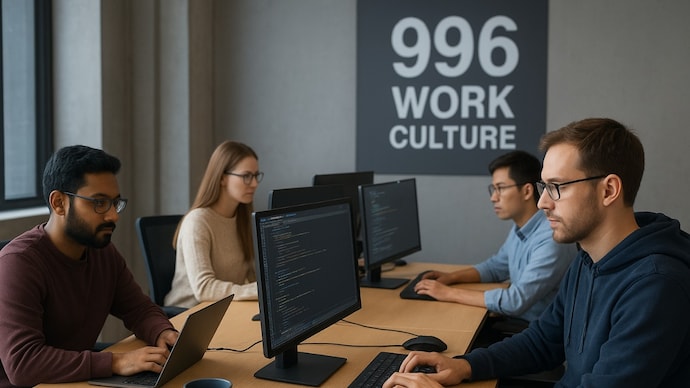
The “996” work culture—derived from working from 9 a.m. to 9 p.m., six days a week (72-hour weeks)—is no longer just an infamous Chinese model. It’s swiftly gaining traction in U.S. startups, especially within Silicon Valley’s competitive AI scene.
Why It’s Taking Off
At the heart of this cultural shift lies fear—fear of falling behind in a heated global battle for AI dominance. Several Silicon Valley startups are openly embracing 996 as a core part of their identity. Some companies even expect their staff to work more than 70 hours a week, offering meals on Saturdays to keep people in the building. These firms frame extended hours as both a badge of ambition and a necessity in an unforgiving startup environment.
Recruitment experts also report an uptick in demand for candidates willing to commit to 996 just to get past initial interviews. Some venture capitalists and startup founders even argue that traditional intense work schedules might not be enough—that building true unicorns may require “007” (midnight-to-midnight, seven days a week) commitment.
Recently, a young Silicon Valley startup CEO publicly advocated 9-9-6, along with a lifestyle of tracking sleep, abstaining from alcohol, and prioritizing physical fitness—provoking a divisive reaction, particularly among Gen Z younger workers.
Roots and Controversies: Where 996 Comes From
Originally popularized in China—especially by Alibaba founder Jack Ma—it became emblematic of extreme hustle culture. Critics lambasted it as “modern slavery.” In 2021, China’s Supreme People’s Court deemed the practice illegal after multiple overwork-related deaths and public outcry.
Despite that, the root model has persisted in many Chinese tech firms, leading to massive online protests and movements like the GitHub “996.ICU” campaign, which decried the health risks associated with perpetual overwork.
daliltechnology.com | collectfan.com | jutzstuff.com
itscrazygames.com | realgearverse.com
Cost of the Grind: Burnout, Health, and Productivity
While 996 may yield short-term gains, studies consistently show it backfires over time. Research has found a significant inverse relationship between worker stress and productivity.
Health experts warn that working more than 55 hours per week raises the risk of heart attacks, strokes, anxiety, depression, and severe burnout. The World Health Organization even recognizes burnout from chronic overwork as a legitimate occupational hazard.
Critics also highlight that extreme schedules may violate basic labor protections—U.S. law mandates overtime pay and sets limits that are routinely ignored in these startups.
One critique frames 996 as a marketing-style fetishization of overwork, where startups lure employees with meals, perks, and myths of heroism, but ultimately sacrifice long-term sustainability and employee well-being.
Voices from the Ground: What Workers and Observers Are Saying
Many industry insiders voice skepticism about the productivity of 996.
One observation often raised is that after 50 hours worked per week, productivity starts to rapidly fall, and after 55 hours per week, there is basically negligible additional work completed.
Another blunt reality check is that many office workers may only get about 6-7 hours of actual work done per day—even if they’re in the office for 12 hours—and on Saturdays, output may shrink to just a couple of hours.
These observations underline the gap between hours worked and meaningful output—long hours don’t always translate to genuine productivity.
In Europe, respected founders and investors label 996 not only unsustainable but also mythic and counterproductive. Many argue that true innovation springs from balance, not burnout.
Alternatives That Work—and Thrive
Ironically, the future of work might lie in working less, not more. A massive trial across multiple countries showed that a four-day workweek improved employee well-being without sacrificing productivity.
This model offers a compelling alternative for startups: high morale, sustained focus, and happier teams—without reducing output.
Walk, Hustle, Recover: What Leaders Propose
Some founders argue that early-stage startups may require periods of intense hustle, but this should be treated as a temporary sprint, not a lifestyle. They promote self-awareness and stress management to avoid long-term damage.
This pragmatic approach is echoed by others who advocate for periodic intensity, followed by intentionally balanced rest—rather than a constant 72-hour grind.
Conclusion: Hustle Smart, Not Just Hard
Silicon Valley’s flirtation with 996 reflects an anxiety-fueled culture—driven by global competition, the AI arms race, and a fear of obsolescence.
-
Pros: Can jump-start projects, boost short-term momentum, and attract gritty talent.
-
Cons: Risks employee health, erodes productivity, may violate labor laws, and undermines long-term innovation.
The smarter path may be to substitute unsustainable 996 with strategies that respect well-being—like flexible hours, focused sprints, and even four-day workweeks. After all, innovation and human flourishing are not mutually exclusive.